Studio Art Honors I
  • Current Assignments
  • Course Expectations
  • Resources
  • Burlington High School Art & Design Program

Expressive Color Narrative

1/4/2023

0 Comments

 
Click here for the project description.
0 Comments

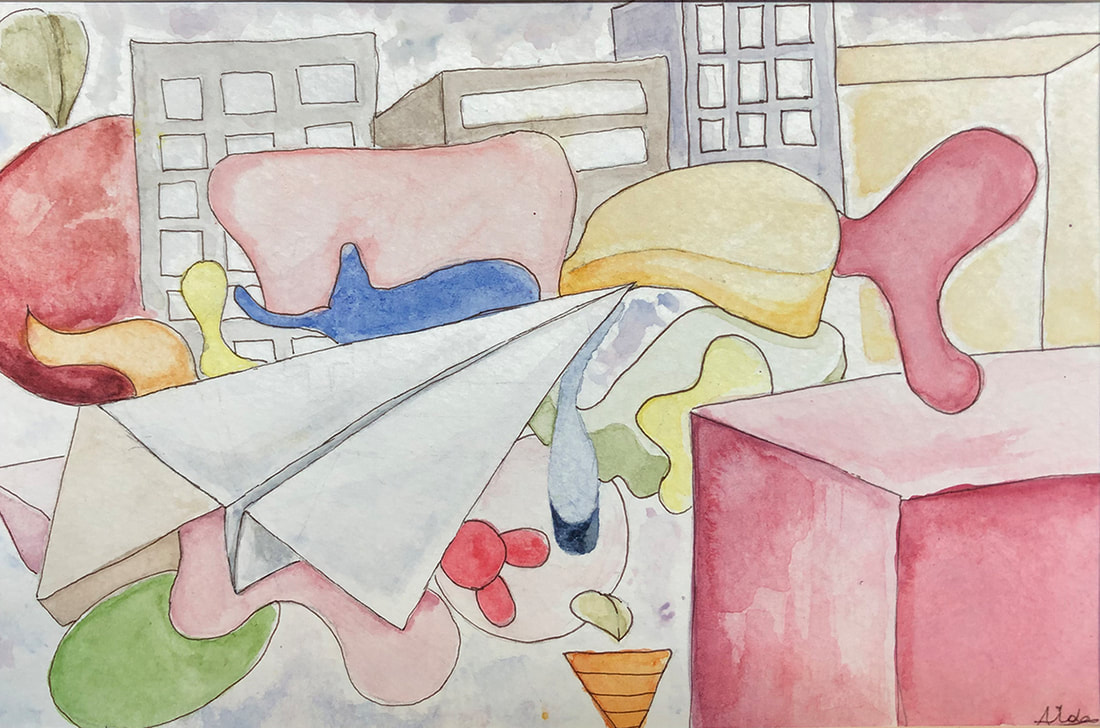
Watercolor Composition : Variety of Techniques

1/3/2023

0 Comments

 
Picture
Aida Gachago, Class of 2020
​

Project:
On a piece of watercolor paper, create a design that considers the Principles of Art, and use that to experiment with different mark-making using watercolors. Apply your understanding of Unity, Emphasis, Balance, Harmony, and Variety in the design.

What you will need:
  • Watercolor set (pan or tubes)
  • Watercolor palette / plastic watercolor pan (for color mixing)
  • Two cups of water (one for cleaning brushes, one for adding to and mixing colors)
  • Sable brushes
  • Paper towel
  • Watercolor paper
  • Pencil (HB)
  • (Salt)
  • (Crayons)
  • (Artist's tape, or masking tape)

Objectives:
  • Learn to control the watercolor medium to mix a wide range of specific colors.
  • Develop skill with watercolor to paint both larger areas and small details.
  • Create depth using atmospheric perspective through color shifts -- More vibrant, and usually warmer, as the objects are closer to you; less saturated, less intense, and cooler as they move away.
  • Learn to paint gradations/transitions of color
  • ​Experiment with the medium

Process:
  1. For inspiration on your composition, look at the work of abstract painters Paul Klee and Wassily Kandinsky.
  2. Create a drawing/design in light pencil line that is composed of at least 20 closed organic and geometric shapes. Compose the image by applying what you know about the Principles of Art, specifically Unity, Emphasis, Balance, Harmony, and Variety.
  3. Then, paint the design using watercolor so that it includes:
  • At least 10 mixed colors (Colors not straight from the tubes, but mixed together.)
  • Washes
  • Smooth, flat color swatches with crisp edges
  • Pale colors
  • Intense colors
  • Gradations of dark to light
  • Gradations of one color changing to another
  • Lines, both thin and broad
  • Points, dashes, and other marks
  • Layers of colors (painting transparent colors over dry colors)
  • All other basic techniques described in this handout (Burlington access only)

If you can't fit all these techniques into a single design, create a second design to try out the remaining techniques.
0 Comments

    Author

    Mr. Ratkevich
    781.273.7024 (office)
    [email protected]
    http://mrratkevich.weebly.com

    Archives

    January 2023
    December 2022
    November 2022
    October 2022
    September 2022
    August 2022
    June 2022
    May 2022
    April 2022
    March 2022
    February 2022
    December 2021
    October 2021
    September 2021
    June 2021
    April 2021
    March 2021
    January 2021
    December 2020
    November 2020
    October 2020
    May 2018
    April 2018
    March 2018
    February 2018
    January 2018
    December 2017
    November 2017
    October 2017
    September 2017

    Categories

    All

    RSS Feed

Powered by Create your own unique website with customizable templates.
